


 David Nicholson
The new Renault 5 is a ridiculously stylish 5 door hatchback that has won awards and rave reviews. It’s good to drive, the list prices are very competitive and it can be very efficient. All sounds very good doesn’t it. I love the looks too and decided a “rapid ownership experience” would be a good way to see what the fuss was about. The aims of this are
- To see what the Renault 5 is like on an extended basis
- Explain some of the foibles and unexpected joys the Renault will bring
- Work out if it is efficient and when. Sorry but the numbers will only reflect summer running because our brief time with the car is in summer!
- It was a good chance to test out the latest Renault and Google software on offer in current Renault vehicles
- and of course provide a few nerdy bits of data!
- I was also somewhat like a bloodhound on the scent about the issues an owner on the Twingo channel raised in a youtube video which I had an initial response to here.
I already have a family EV and don’t need a second car so the fact that I am running the Renault just for a few weeks is very much a positive not a negative.
My summary of the Renault 5 before
In our A-Z of electric car deals before an ownership experience this was our entry for the Renault 5. In case you’re wondering 7/10 is a high score on the A-Z scale.
5

- Deals boost – not yet but it’s well priced at RRP making list prices for Mini look ridiculous.
- Why you should? Seriously chic and head turning with fun colours and a low start price. It’s also good to drive, refined and comfortable and has good google in car software. This car could convert a new audience to EV’s as people just see one and want it!
- Why not? Charge speed and range are so so, rear passenger space is tight and charge port location is not ideal for Tesla superchargers. Also no sunroof option yet and no one pedal driving option yet. Sacre blue.. the 4 haz it!
- Sweet spot of the range is 150hp with larger comfort battery 52kWh battery that charges at up to 100kW. In Techno spec the RRP is £27k. It looks good in standard spec including wheels but for the best look I think the roughly £400 for contrasting roof helps the look at probably re sale prices too. If you want adaptative cruise control to steer on the motorway you will need the top spec
Things to know before buying a Renault 5
Choosing and buying
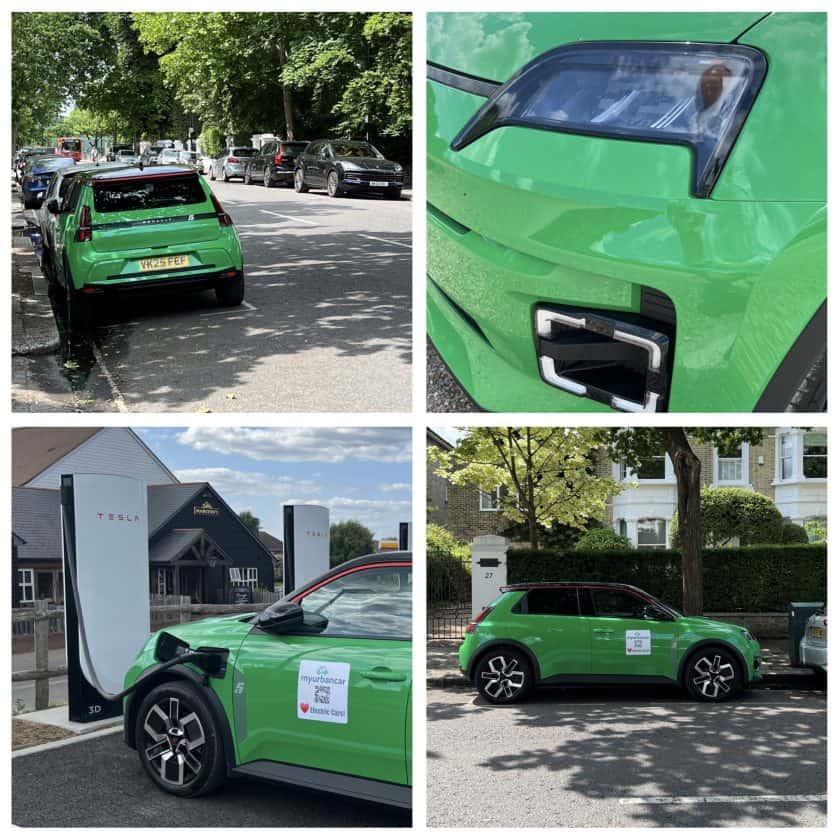
Well as you can see in the “Sweet spot” above, choosing a model was easy – a mid spec techno with bigger comfort battery. I like pop yellow with a black roof but my favourite was pop green and using the Autotrader link in the A-Z of deals that happened to be the best option. The purchase had no involvement from Renault UK and or even a Renault dealer. The buying experience was excellent and I was of course further reassured by the fact this was a new model with just 37 miles on the clock. Deals will improve once the Renault 5 becomes established but at the start of June 2025 discounts are tiny. Click on the link to find the position today on Autotrader.
Purely subjective but it’s a very good looking car and the interior looks good too with the techno spec “denim” material really providing a nice vibe. All in all it’s a happy place to be.
Apart from local drives in SW London our plucky R5 has been to Dover, the beautiful Derbyshire peak district and Bath on everything from single track road to motorway. It’s been happy on all of them
driving and ride
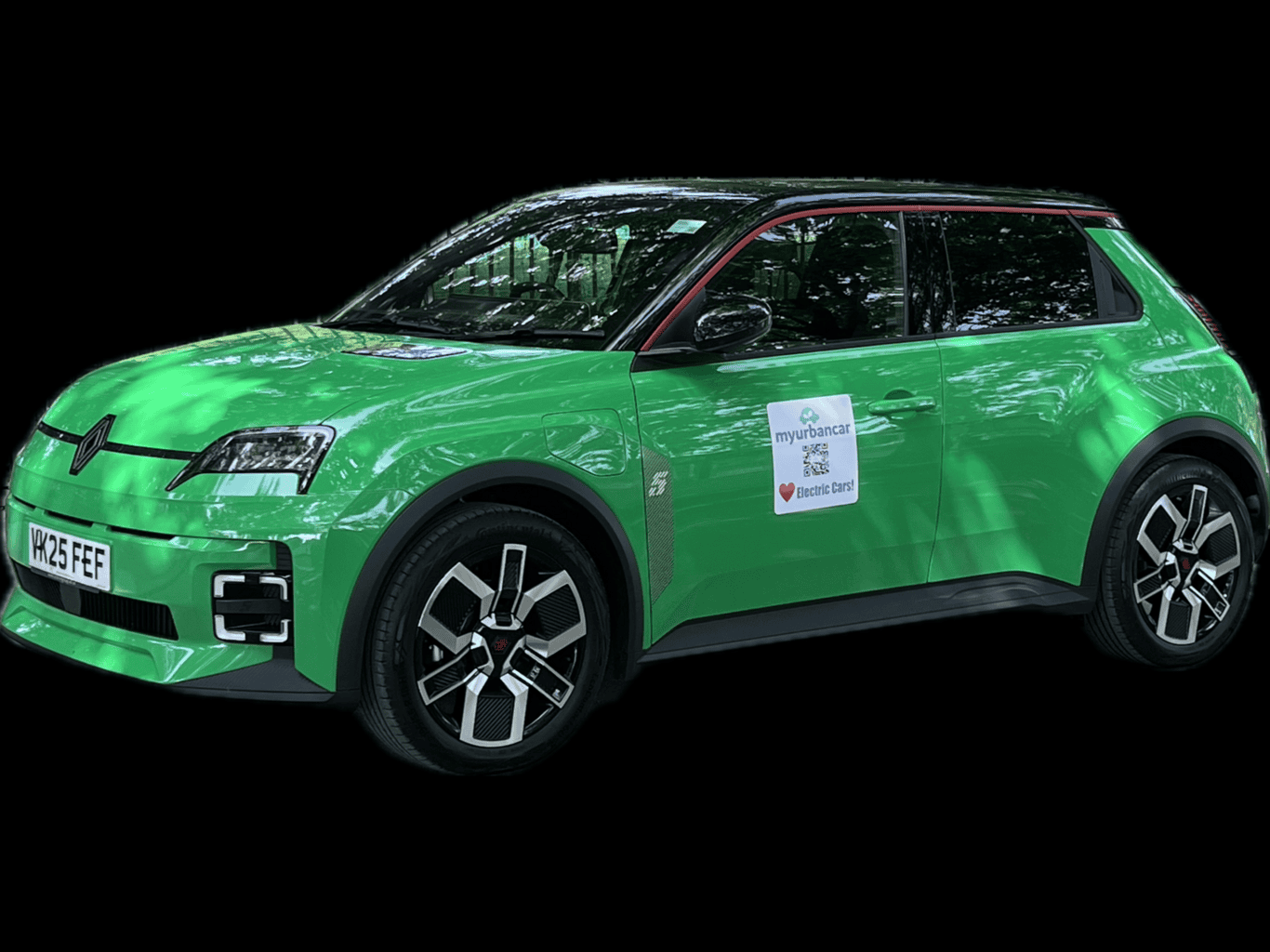
- The car feels confident on twisty roads although you sit higher than you might expect (or I did, you can lower the seat!). The plus side of that is it will suit buyers of all ages as access is easy.
- Turning circle is excellent and generally the car is quiet (although some road bumps and UK “imperfections” do add some noise).
- There is some wind noise at motorway speeds but it’s not that obstrusive. Being front wheel drive there can be torque steer but I haven’t noticed any issues with this in normal driving.
- I’d say the ride quality is good and on the firmer side. On larger bumps and dips you do sometimes notice you’re in a shorter car but it’s a very rare event.
- Acceleration is brisk at all legal limits including up steep hills to the extend that it was able to easily outpace a Range Rover going uphill on one country road helped the fact the Renault 5 is often slim enough to pass oncoming traffic country roads where a Range Rover’s girth forces it to a halt.
adaptive cruise control
My current usual drive is a Tesla Model 3 and the Renault adaptive cruise is generally better. It is excellent at motorway speeds all the way down to urban stop start traffic. The minimum cruise speed you can set is 19mph (so you can use it to avoid getting carried away in 20 mph zones) but it will brake and accelerate all the way down to a stop. Compared to Tesla autopilot it’s much smoother and less jerky at especially slow speeds, quicker to keep up with accelerating traffic ahead and useable in town without the jarring phantom braking the Tesla suffers from. Having added more miles there is occasional phantom breaking (mostly on motorways) but it is gentler than the same experience in my Tesla.
The techno spec does miss out on auto steering so the Iconic spec which steers and keeps you in lane might be more relaxing for long motorway trips. That said steering would involve a more able system and I don’t know how it this works in practice.
Controls for cruise are on the left side of the steering with one to cancel cruise, one to initiate and adjust speed and a handy button that adjusts your speed to the current speed limit. All easy to use.
Worth noting the speed limit reading isn’t perfect but what car has a perfect system. Usually this is invented lower Motorway speed limits like a 50mph when the electronic signs show no such thing. It’s rare enough to be a foible and doesn’t affect your ability to keep your cruise control at a higher speed.
B mode
B mode is easy to select (the drive stalk alternates between drive and B mode). What is B mode? It gives you stronger regenerative braking where the motors slow you down and at the same time recharge your battery using that braking energy. It slows you to a crawl not a stop so you still need to use the brake pedal a bit but the braking effect is still strong enough to do most of the work if you anticipate a bit. It is likely that future Renault 5s will get even stronger one pedal braking down to a stop as the new Renault 4 and Nissan Micra will come with this.
While I too would prefer full one pedal driving the Renault’s regen is strong and very close to a one pedal setup until you get below 5mph so it’s still a pleasure to use. When I say strong, on a 20% slope it still provides enough braking energy to slow the car for corners and urban limit signs. It’s easy to live with and easy to select via the drive stalk.
controls and ventilation
Overall after an initial learning curve it’s all pretty straightforward. Auto wipers worked well on the rare occasions they were needed. The media stalk doesn’t really do it for me as it counter intuitively seems to use a plus or minus button for volume and a dial to skip tracks. I’d rather the dial did volume.
The physical buttons between the front seats work well. If you’ve turned ventilation off you can just flick the fan speed up to restart it. You can manually set to recirculate cabin air when you’re stuck behind the stink of diesel burning vehicle. Sometimes it cancels after a few minutes.. sometimes not. I’m guessing it depends whether you flick the switch up or down but I haven’t confirmed this. The face vents are very effective for cool air in warm air and easy to direct.
charging
After testing on DC chargers from Tesla (V4 only), Sainsburys, Eon, Zest, Be.ev, Evpoint, Applegreen and FastNed electric charging has been flawless. On the trip Dover below where I arrived with 3% and with no battery pre conditioning the snapshots of speeds were
- 90kW at 3%
- 92kW at 7%
- 97kW at 8%
- 100kW at 12%
- 94kW at 25%
- 86kW at 36%.
then I went for a coffee but 27 mins took the battery from 3% to 71%. It took 10 mins for the first 33% charge and next 35% took 17 minutes.
The position of the charge flap for older V2 and V3 Tesla chargers with short cables is difficult and perhaps impossible in many cases.
Simple AC charging also worked fine but some owners have found that that when using the Renault 5 on an dynamic smart electricity tariff like Octopus Go the car has a glitch that makes it fall asleep and not charge. If you do have this issue there is a suggested solution here. Hopefully a software update will resolve this soon.
efficiency and range
We cover this below under “Navgate” but a disciplined 70mph in warmer weather with AC and music running and in comfort B mode should deliver 3.6 to 3.9 miles per kWh while introducing some slow moving urban drives should raise this to between 4.4 and over 5 miles per kWh.
Over 1,304 miles the Renault app says 316.05kWh has been consumed which works out as a very plausible 4.125 miles per kWh. This sits within the indicated consumption which was generally 3.8-4.3 with outliers as low as 3.3 and as high as 5.9.
This was in comfort mode with AC mostly on (except when windows were down) and never in eco mode. On the most recent trip from London to Bath and back first charge was a 163 miles when it reached 7%. It started the trip with 90% so a mix of all SW jams, 70mph M4 and some 50mph A roads delivered a 100% range of around 196 miles.
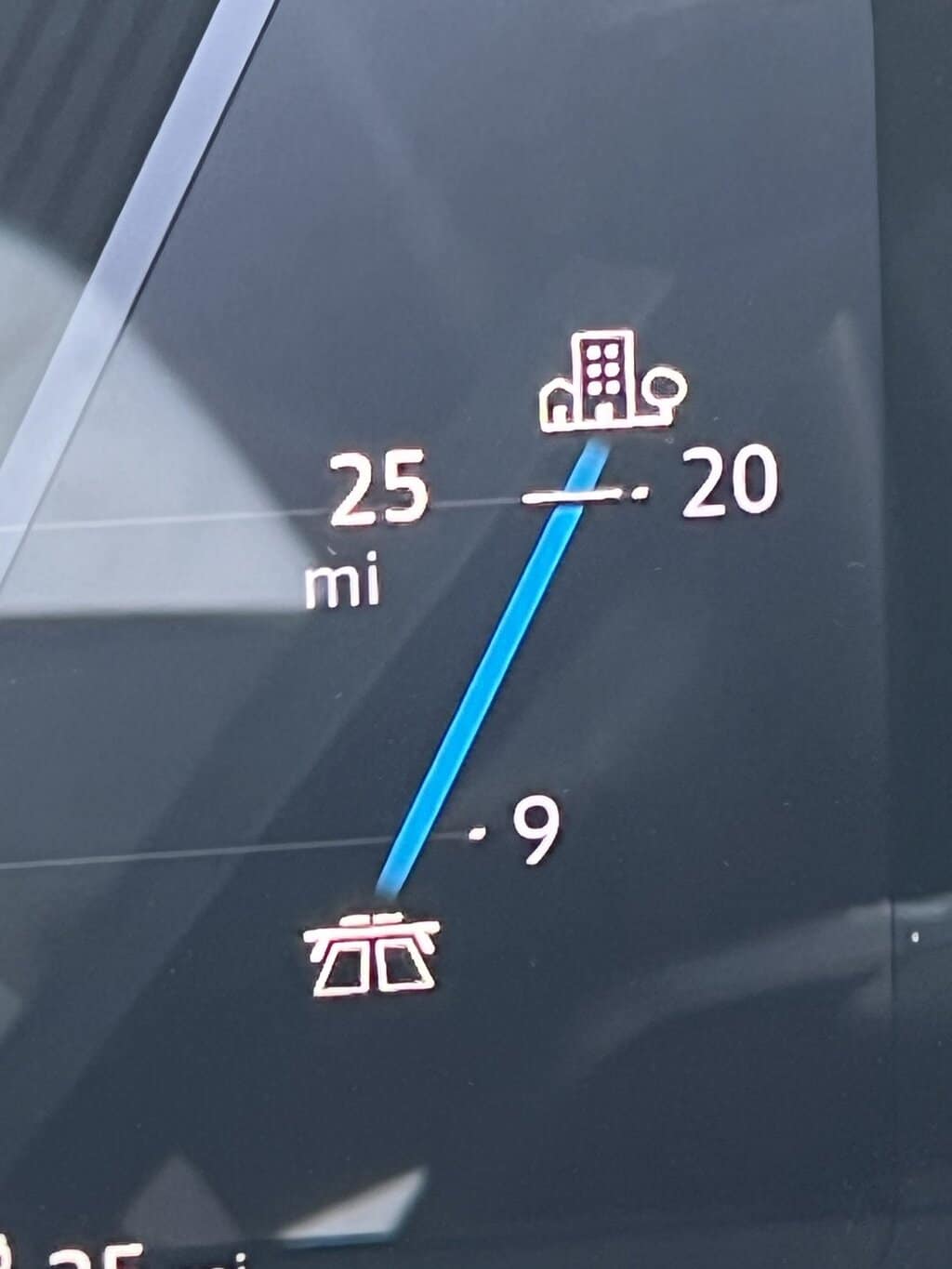
As you can see above efficient summer driving on a mix of roads can deliver close to or even sometimes more than the predicted city range. For example a trip that involved going from almost static Southwest London traffic, down the M4 as fast as a Friday would allow then some more jams in Bath delivered the equivalent of 212 miles 100% range. A trip from London up the M1 to a charge stop in Nottingham was delivered the equivalent of 191 miles 100% range. It’s not always that good but it’s achievable even on a journey comprising London jams and motorway. Even a journey where I thought the warm weather range was a little disappointing was equivalent to 183 miles.
the tech
I don’t regularly use Apple carplay so this may be a general issue but it can get a little confusing which system is listening out for voice commands as at different moments it might be “hey Reno” (it doesn’t answer to Ronny or Renault in case you wondered) or “hey google” or “hey Siri”. It seems that only one of these 3 systems can listen for commands at any one time and once you start a journey the “hey Reno” system becomes pretty hard to track down. It’s possible there is a simple solution as I didn’t get a dealer walk through.
As I only have the car for a short time I haven’t logged into a google account which would presumably allow me to run spotify without using my phone battery or data. Without doing this you can be listening to something on spotify but to get the car to start playing it seems to involve
- Opening apple carplay
- opening spotify
- pressing the play button or finding the thing you were listening do and then pressing play
This all seems clunky compared to Spotify just playing when you get in. I suspect using Spotify on the car’s google app would solve this.
The google navigation works well, re routes based on live traffic data, warns of speed cameras (a subtle chime) and suggests charge stops. On my first trip I found the navigation system had a very very pessimistic opinion of how much battery you would have remaining at your destination. See in depth below on this topic.
One small issue to note. I only tried this once but it seems if you select the navigation in the drivers display it just shows a more general map view in the centre screen. On the plus side if you prefer apple maps on Carplay they can navigate you via the drivers display.
As a general issue I think most owners will be able to access what they need but the menus and workings of 3 competing voice commands should be clearer and more intuitive.
Quick takes
On the plus side do experiment with the Google tech in the Renault 5 as it does have some real abilities. For example if you use the voice command “navigate to a eon charger near Nottingham” (300kWx6 at 63p/kWh) or a Zest charger near Alfreton (120kWx6 at 65p per kWh) it will send you to these great value chargers without needing any address. It does have limits though.. you won’t get the nearest Zest charger to Nottingham if you don’t know what town it’s in even its the nearest Zest charger to Nottingham.
- Hands free locking works well and the car does remind you if you haven’t turned the car off before getting out but it won’t warn you about open windows and will even lock as normal with a window down!
- The charge port is manual but it does warn you if you drive off with it open (don’t ask how I know this!)
- Renault were a bit slow to provide a UK manual for the Renault 5 but it has arrived now along with helpful guide videos. The video shown about regenerative braking and one pedal mode describes steering wheel paddles the Renault 5 does not yet have but may do after a future update. It does have B mode which I mentioned above.
- After 1,300 miles I have found the front seats very comfortable on longer trips and my wife who often finds the Tesla Model 3 seats poor on long trips had no issues on a trip to Bath and back.
Verdict
I’ve found a few issues here and there (see below) but in case you’ve been left wondering, I think the Renault 5 is a great car, not just a good one. The design inside and out just puts an inane grin on your face, it drives well from on anything from London 20mph zones to motorways to country lanes. The charging side works well and I’d happily take it on road trips anywhere in the UK. It’s relaxed driving slowly but left in comfort mode has all the power you need for hills and overtakes. In all it’s a rare combination of small AND grown up.
Overall the pluses more than offset the pricey roaming charger card that is best left alone and the curiously pessimistic Google navigation estimates that I am sure will be fixed with a software update soon.
I’ve taken the family from London to Bath with weekend luggage and the performance and handling remained on form and everyone had a comfortable journey, If you want more space the Renault 4 brings the 5’s talents in a larger form. But if you want a Renault 5 because of how it looks, it’s talent’s are there to match. I’ve been sad remove the MyUrbanCar logo and see it go.
A few places our Renault 5 has been in a month from Derbyshire Peaks to Dover cliffs and Somerset dragonflies to Henley rowers. Over 1,300 miles from using 290kWh charged from Applegreen to Zest.


In depth for owners
Phone charging
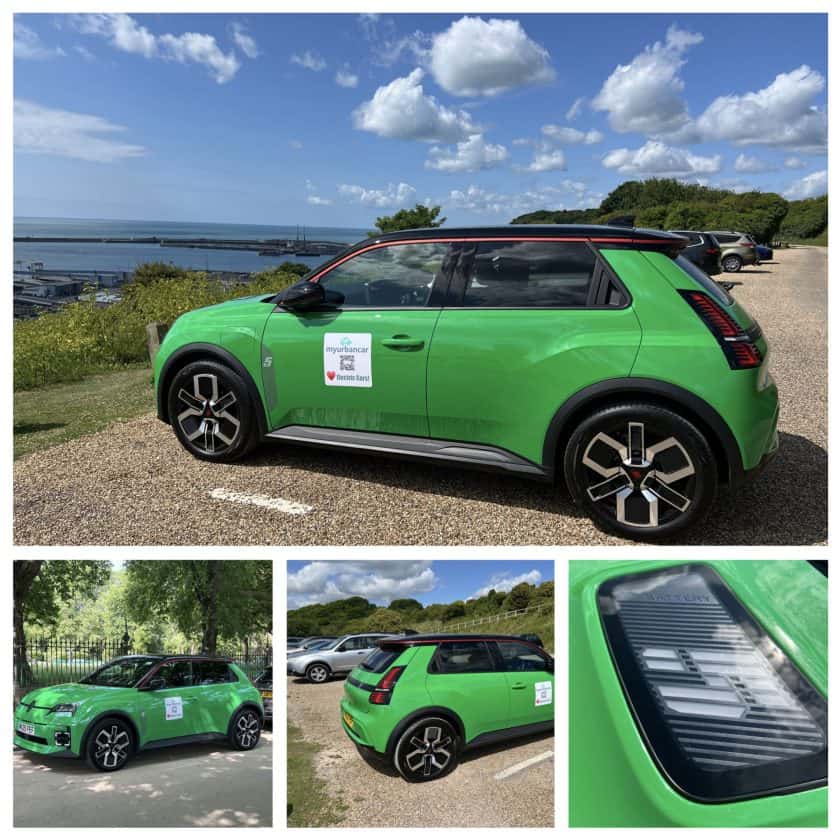
- The good news is the inductive charge pad has a light that shows when your phone is charging and a good grippy mat to hold the phone in place
- The bad news is if my experience is anything to go by you may not see the light very often and for UK drivers its on the far side of the phone and therefore obscured without leaning over
- The charging pad seems very particular about where the phone is placed (certainly on my iphone 13 with my case). You may want to check its sweet spot before you drive… mine needed to be placed about a centimetre from the back of the pad with the bottom of the screen swivelled 180 degrees and even then didn’t work reliably.
- I would take a USB C phone cable in case the inductive doesn’t play ball. I initially had trouble charging off this too but rebooting my iphone resolved this completely.
Mobilise Charge pass
If you are a new owner you’ll be glad of a charge pass being provided by Renault that allows you to pay easily at many UK chargers. Only thing is you really shouldn’t ever use it. Why not?
- The prices are offered via the pass very from poor value to eye watering. In fairness similar issues can arise with additional admin fees on other charge passes but the fees here do seem extra high.
- The Mobilise charge cards have paid membership options but if you have the free version you might think they offer you discounted charging but in the cases we’ve looked at they substantially increase the charge costs.
- Bear in mind that almost all UK DC chargers have contactless payment options and charging operators often discount for using their own apps.
Lets look at 3 examples. The Shell DC charging hub in Fulham is a lovely facility but the faster Shell DC chargers are the equal most expensive in the UK market at 89p per kWh with contactless payment. Now I happen to have the Shell Recharge app (which can also be used to pay for chargers all over Europe). Paying with the Shell app cuts the price to 79p per kWh.
What about the Mobilise price? Well frankly it took me a while to track down the prices. Here is how.
- Open the map tab in the My Renault app
- Click on the plug symbol to see all the chargers
- Click on one and then scroll down to choose a plug and select one
- The prices are then displayed
So the price for that Shell charger? 97.9p per kWh so 10% more than just paying contactless on the charger and 23% more than paying with the Shell app.
What about Gridserve at Amesbury? 79p on contactless but 86.89p per kWh if you pay via Mobilise. So about 10% so you know where you stand?
Till you get to a Shell Ubitricity lamp post charger. 54p per kWh via the Shell app. Less if you use the QR code on the lamp post. But use Mobilise and that 54p per kWh goes up to £1.0428 per kWh and..a £1.32 admin charge on top. So if you pop on for a 10kWh charge the price you pay would reach an eyewatering £1.17 per kWh.
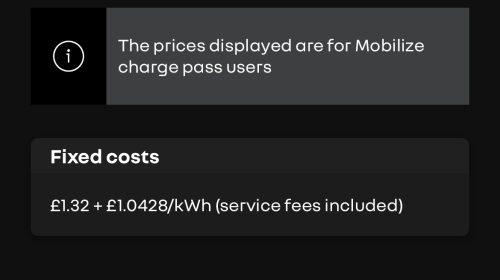
By comparison Octopus electroverse costs 59p (a 5p surcharge) for the lamp post and 89p for the Shell hub in Fulham. It cannot access the Gridserve charger but the for the Amesbury Instavolt charger nearby the cost is the same high 87p as you would pay contactless on Instavolt. The same Instavolt charger on Mobilise would set you back 95.7p per kWh. Neither charge card can be used on the Tesla superchargers at Amesbury that costs just 54p at peak time for non Tesla’s.
Even if it’s just an admin fee, new owners should be told the charge card will often or always be the most expensive way to pay if no subscription is purchased. The fact that even the receipts provided don’t indicate the price per kWh charged could give some the perception that they are being fleeced deliberately. I’m sure that’s not the case but transparency is needed and this is a slight of hand others including network operators are employing too. Think your prices in pence per kWh are too high to interest customers? Hide them before and after a transaction appears to be the mantra.
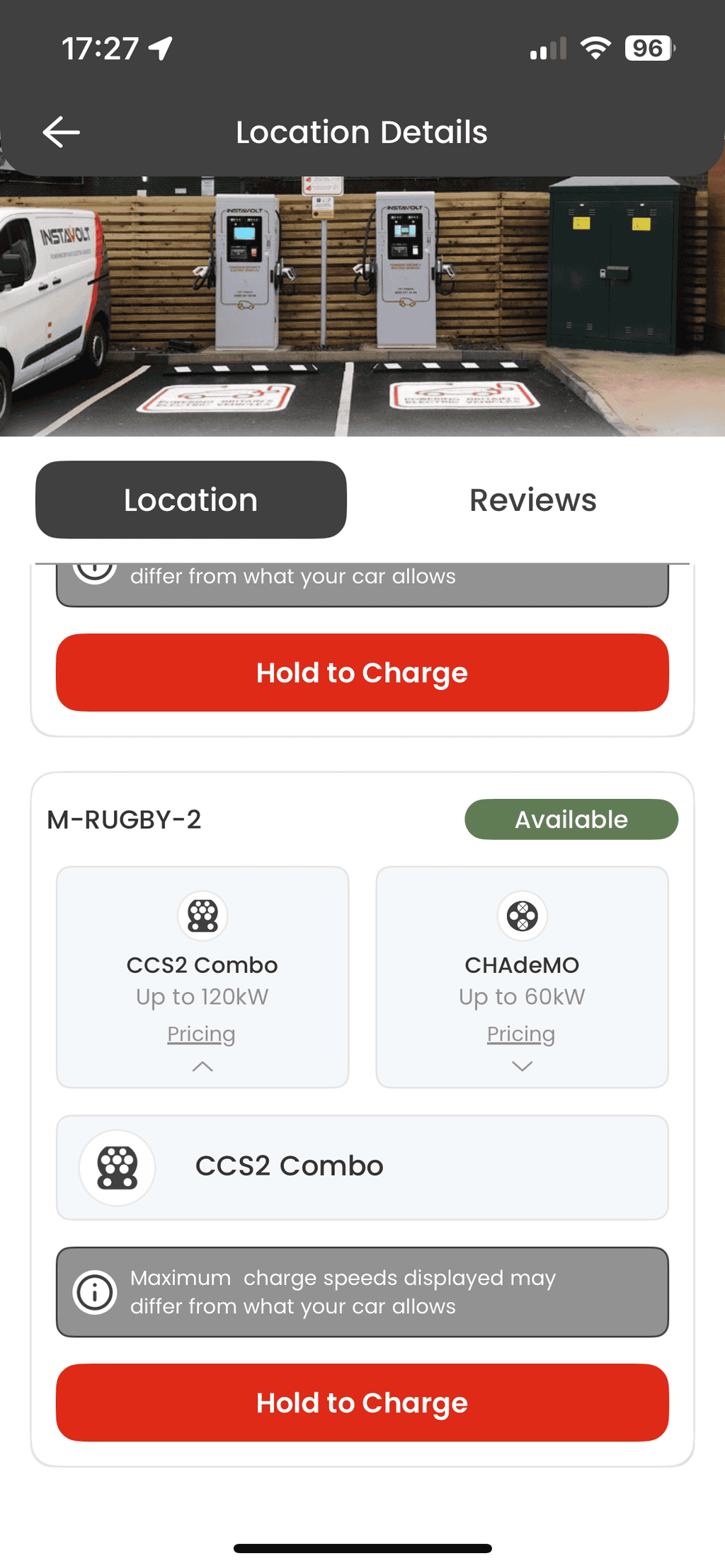
Just as an example try finding the price of an Instavolt charger if you’re a customer using their iphone app. The screenshot is after you’ve selected the pricing dropdown which does not tell you the price of the charger you are about to use. If it’s a “technical glitch” it needs addressing.
Well having picked up our test Renault 5 in Somerset I noticed something odd. On the last leg back to London I started from a hill at Ham Hall country park, 125 miles from my destination in London.
- The car was showing about 30 miles more range than that or just over 155 miles yet the Nav system said I wouldn’t make it and suggested a reasonably long charge stop.
- Throughout the journey the indicated range remained between 20 and 30 miles above the distance remaining
- Because I diverted from a major traffic jam on the A303 the journey was actually longer than the original Google nav route by an additional 8 miles.
- Throughout the journey google nav said I would arrive with between minus 1% and minus 7% charge on arrival.
The estimated range on arrival was regularly fluctuating but as I got closer to the destination I expected the number to move closer to the correct range that the car was indicating all along. But it didn’t. Just 13 miles from the destination google was estimating a minus 6% battery on arrival when the indicated range was 33 miles and I still had 12% remaining.
On arrival I parked in the next street to mine to plug into a cheaper charger with 8% charge and 26 miles of range remaining. So it turned out the last 13 miles of the trip only used 7 miles of range delivering a rather staggering 6 miles/kWh thanks to 40 then 30 then 20 mph London speed limits.
That wasn’t the really odd thing though. I still had my navigation set to my home round the corner which Google said I was just 0.2 miles drive away. But while the Renault 5 confirmed I still had 8% charge Google said if I drove the 0.2 miles I would arrive with.. minus 7% a gap of 15%! That’s when it struck me that maybe someone had told google to deduct 15% from the car’s actual range on arrival. This suddenly made sense of the wrong estimate on the journey… where google was displaying minus 5% for a plus 10%.
Did the pessimistic range estimates continue?
I did a trip from SW London to the National Trust White Cliffs of Dover car park in Kent and set a waypoint at the Upper Harbledown BP Garage on the A2 simply to ensure I didn’t go near the M20 Brexit lorry park. After Dover I stopped for the first and only charge at the new Tesla Superchargers at the Macknade farm shop in Faversham.
| Start 71% Battery 171 mls Range | BP 80 miles | Dover NT 103 miles | Faversham Supercharger 128 miles return leg |
|---|---|---|---|
| Google original battery % on arrival | 19% | -6% | -9% |
| Google original estimated usage & Equiv 100% range | 52% 153 miles | 77% 138 miles | 80% 160 miles |
| Google est+15% | 34% | 9% | 6% |
| Actual % on arrival/ Odometer miles | 31% 76.9 miles | 19% 96.9 miles | 3% 125 miles |
| At departure after moving to less dusty spot | 14% 97.1 miles | 27 min charge to 71%/ 162 miles range | |
| % on return to London | Google est 28% | ||
| Actual | 31%/ 71 miles range 198.2 miles final trip miles | Total battery used 108% equiv 100% range 183.5 miles 3.52 mls/kWh | |
So I think the results do disprove my “google is always 15% wrong theory but Google remains unduly pessimistic. A few points to note on the stats above
- Aircon and music was on and the car was in comfort mode and B mode throughout. I never in eco mode at any point
- I made a wrong turn that added some miles on the trip to Faversham and the car mysteriously lost 5% charge shifting to a different car park at Dover before I left. As a result I did have to enhance my Jedi EV efficiency skills to the max on in order to arrive with 3%! Mainly this involved even more anticipation of braking and sticking to 60mph on the dual carriageway. There were plenty of other charging options that I could have stopped at and google encouraged me to do so! Had I not maxed efficiency the google prediction when I was leaving of 0% on arrival would have been pretty much bang on.
- In case you’re wondering what the Renault does in a low battery situation there was no drama, charging options were offered but from 5% battery and below the car refuses to display range. That’s an odd choice but as each 1% is just over half a kWh my 3% was somewhere around 5 or 6 miles.
- Google looked a little less pessimistic than it normally would because the car was pretty inefficient overall at 3.5 miles per kWh. I’m not sure what contributed to this but temp was a little cooler (15c-19c) outbound, all the motorway sections were clear (yes even M25) and I may have driven a little less efficiently! 3.8 or better should be achievable on motorway runs at 70mph and 4.5-5.2 in town esp 20mph areas should work outside of the colder months that we haven’t tried.
- Has it got better over time? Well on the London to Bath trip I failed to note the Google prediction outbound but I the car used 51% of the battery on a route Google said is 112 miles so equivalent to 219 miles range. On the way back after a 28 minute charge from 7% to 61% at Royal Wootton Basset Google predicted I would have just 10% charge on arrival. And what did I arrive with? 22%. Earlier Google had predicted a 48 minute charge would be needed to arrive with 30%. So what happened here? Well Google expect the 100% range of the car on this 82 mile trip to be just 160 miles. The Renault 5 actually managed 210 miles equivalent 100% range. Google was spot on at predicting the miles to travel and did after some adjustments get closer the arrival time which was about 40 minutes optimistic on departure
- Just checked Google’s prediction for how much battery the 112 mile trip from London to Bath would use.. 69% compared to that 51% actual last week or 28% worse than the reality. So after 1,300 miles Google is still assuming that 100% battery gets the Renault 162 miles.. that’s a difference of 57 miles!
How does all this affect owners?
Having a overly pessimistic range on arrival essentially means owners need to charge more often than they need to and think they have less range than they really do have. This is exacerbates the usual range issue that nobody charges to 100% then runs the an EV to 0%.
- If an EV has 200 mile range on 100% to zero but you use it in a normal range from 80% to 10% then your distance between stops is 140 miles or 180 miles if you go from 100% to 10% for a long trip.
- If your navigation system thinks the car can only travel 150 miles on 100% charge then normal range between stops drops to 105 miles and even 100% to 10% drops to 135 miles between stops
- It’s possible these google estimates will improve with time or maybe google thinks that June is the middle of winter in England.
In the meantime if your range is 20-30 miles more than the google estimated distance to your destination and you have further charging options all along the route you may well be able to continue even when Google’s “glass half empty” prediction is doom and gloom. If you don’t have charging options or the gap between the car estimate and google falls below 20 miles eg 40 miles to destination but just 50 miles of range estimated then it would be safer to charge before continuing. Obviously if there is no charger near your destination you will need enough range to reach a charger after your destination. All this involves some common sense and experience will help you judge when to ignore google and when not and this is at your own risk. You can be more confident in an area with lots of chargers but need to be much more cautious in remote rural areas like the highlands of Scotland.
Quick takes
- Occasionally it’s hard to switch out of neutral. I think the R5 expects you to select drive or reverse quite soon after you first press the start button on. If this happens then just press start again before selecting drive or reverse.
- There is a steering wheel button that alternates between cruise control, speed limiter and off. Leaving it in cruise mode is fine but do be careful about accidently selecting speed limiter, especially on a motorway on ramp as it will limit your speed to the set speed which could be a safety issue. Not a biggie but I would rather the speed limiter was not present as cruise control maintains a set speed anyway.
- If your phone doesn’t connect via bluetooth I have found walking far enough for the R5 to lock and then getting back in seems to resolve the issue.
- If you get a nudge in the display to take a break then flicking the right hand steering wheel up and down switch (normally used to change the right hand side of the cockpit display) will clear it.
- that pessimistic google range estimate is exacerbated by the fact the navigation system will slip its recommended charge stop in without asking. To check, use the waypoint symbol on the nav (bottom right) to check what stops it recommends and delete charge stops if not needed. It’s worth noting that if you simply ignore the charge stop google will doggedly leave it as your destination even off to gone past it! For example driving back from Bath to London the NAV had decided I should stop in Reading, and still wanted me to go back even when I was a couple of miles from my home in London!
R Symons Review on the same car
Richard Symons has sold a few of our EV’s in the past and took the opportunity to do his own review of our Renault 5 here. What does he think? Watch and find out.
Updates
This page will get some updates probably till then end of June while I still have the car. As Rob from the Twingo channel discovered the Renault 5 is an excellent electric car but new owners should get a bit more guidance on those range estimates and should be given a better charge past offering to ensure their ownership experience remains positive.



[…] my 1 month 1,500 mile test of the fabulous Renault 5 I decided to use the opportunity of driving a non Tesla to see if I could save money by using […]